


RELATED LINKS
RELATED LINKS
RELATES LINKS
RELATES LINKS
Services
Related Links

Use and Management of Cookies
We use cookies and other similar technologies on our website to enhance your browsing experience. For more information, please visit our Cookies Notice.
- Personal Banking
- Stories & Tips
- BUSINESS MAKER
- Lean Digital Canvas Reduce wastage create added value Enhance productivity
- Personal Banking
- ...
- Lean Digital Canvas Reduce wastage create added value Enhance productivity
 Share
ShareLean Digital Canvas Reduce wastage create added value Enhance productivity
23-06-2023
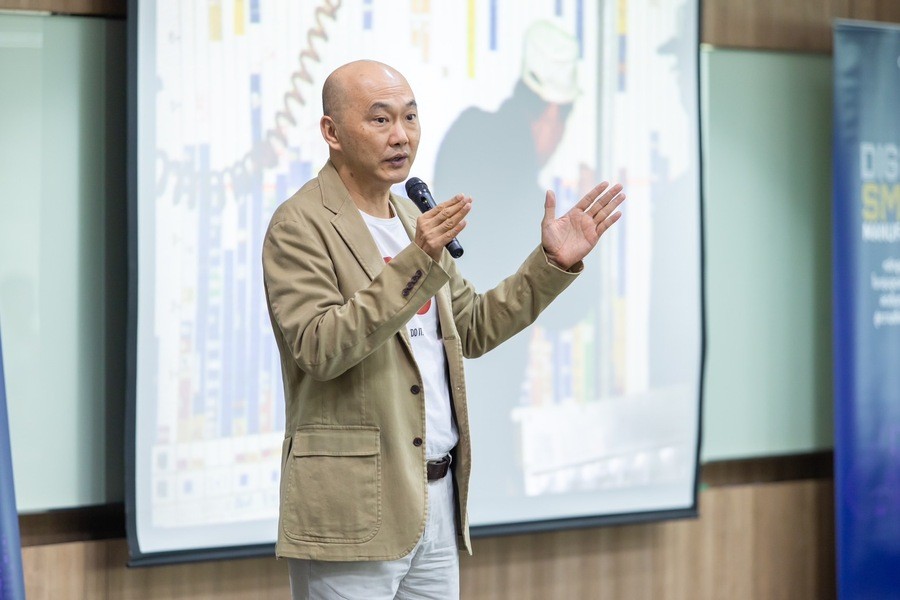
LEAN is a concept that reduces waste in the production process. Suitable for factory or production operators. by turning waste into value This makes it possible to manage the production process more efficiently. It also helps the cost of production very well. Dr. Suriya Lertwattanapongchai Lean experts and consultants share their knowledge with participants in the Digital Smart Manufacturing course for SMEs in the manufacturing industry to reduce costs, increase productivity, and achieve ESG sustainability with IoT.
KNOW KAIZEN FOR THE BETTER CHANGE
Dr. Suriya said that if LEAN was abbreviated to make it easier to see There will be only about "Value" and "Waste". An important tool in doing LEAN is Value Steam Map. It is a tool to help clearly see the flow and waste. Focusing on visibility and eliminating or reducing waste without waiting for perfection, is to do it gradually like a Japanese management strategy called KAIZEN.
KAIZEN Principle of KAIZEN
· Delegate responsibility for results to frontline workers (Empowerment)
· Have goals for QCDPIS (Quality, Cost, Delivery, Yield, Backlog, Safety).
· The assumption is that if the work meets the standard (Standard Work), the result should be the target.
· When an abnormality occurs Employees will gather to analyze the cause and take action to improve.
· Employees will summarize their improvements and learnings in an A3 report.

Dr. Suriya gave an example of Fast Cap in the United States that The factory manager has created a factory culture called the Morning Walk. It is a daily walk to the production line in the morning. to greet all staff and asked the staff What would you like to improve today? do anything better To save 2 seconds, plant managers doing this can be a double-edged sword. Must talk and understand with employees that it is not a mistake. but to create a corporate culture The executives must be consistent. must be seen as an example every day Once the employees have adapted, they will stay on their own. Maintaining the standard of the factory is something that cannot be neglected. Leaders make these cultures possible.
GEMBA Japanese work culture
Dr. Suriya mentioned GEMBA as part of the LEAN principle as well. The word "GEMBA" in Japanese means "real place" consisting of 1.Genba, a real place such as walking out to explore the actual site 2. Genbutsu, real things, such as going to see, holding, observing the real product 3.Genjitsu, real situations, such as going out to see the real problem situation 4.Genri, the theory that is actually relevant, such as looking at production standards, and 5.Gensoku, real related conditions, such as looking at clauses Limited, see the regulations that apply.
The principle of GEMBA is to see it with your own eyes. To see the facts, don't think for yourself, walk out to see the real job site. And it is also considered to respect the opinions of employees. The boss will not continue to say But if you want to improve Might ask for opinions to help Brainstorm and try to see if What will the new method be? to improve or modify and then wait and see what the results will be
There are also 3 things that lead to waste (3 Contributors to Waste), consisting of 1.MURI (Overburden) means too heavy to do. Do not allow employees to exceed human limits. 2.MURA (Unevenness) means unevenness 3.MUDA (Current Process Methods) Current working methods that cause 8 wastes, namely 1. Defects 2. . Moving (Transportation) 3. Excess Processing4. Inventory (Inventory) 5. Overproduction (Overproduction) 6. Waiting (Waiting) 7. Movement (Motion) and 8. Inefficient use of human resources. (Non-Utilized Talent)

Get to know PDCA, how to create a quality management cycle
Dr. Suriya mentioned that PDCA is creating a culture of thought to provide feedback and to always check the creation of new knowledge, consisting of 4 steps: Plan- Plan Do-Do-Do-Check- Check and Act - Improve is a process used to improve the work to be systematic. The goal is to solve problems and develop continuously. To achieve good results, Dr. Suriya said that leaders must lead by example. Let employees see and understand, it will enable PDCA to be successful.
SMED streamlines production
SMED stands for Single Minute Exchange Die or reduction of installation time is the Set-Up Time of the machine as quickly as possible. From the last piece of the previous production process to the first piece of the next production process. This is to increase the flexibility of production.
consists of 5 principles
1. Separate the External Set-Up from the Internal Set-Up.
2. Convert Internal Set-Up to External Set-Up
3. Improving Operation Methods
4. Improve equipment
5. Eliminate Set-Up
Before parting, Dr. Suriya said that if SME entrepreneurs can understand the principles of KAIZEN / GEMBA / PDCA and SMED, it will be an important tool for doing LEAN within the organization more efficiently. And most importantly, making LEAN successful. Relies on the business owner as an initiator and acts as an example. for employees to recognize and understand able to adapt And put into practice until the organization's culture. This causes changes and will lead to LEAN within the organization sustainably
Source: Dr. Suriya Lertwattanapongchai Lean expert and consultant, director of the Digital Smart Manufacturing program for SMEs in the manufacturing industry, reducing costs, increasing productivity for ESG sustainability with IoT in May 2023 at Siam Commercial Bank, Ratchayothin Headquarters.