



- Overview
- Policy
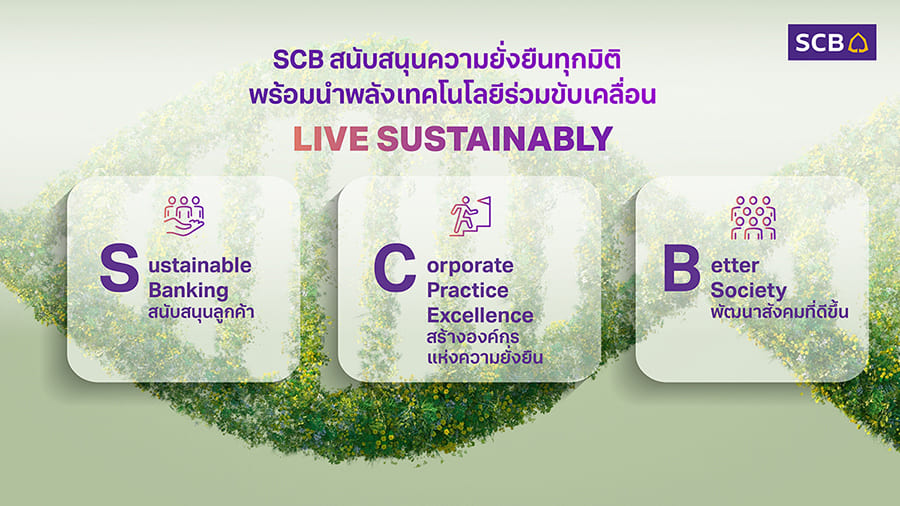
- Sustainable Banking
- Corporate Practice Excellence
- Better Society
- Sustainability Foundation
- Reports & Disclosures
| Level | Committee / Unit | Roles and Responsibilities |
|---|---|---|
| Board of Directors Level | Board of Directors: BOD | Approves policies and strategic direction, oversees sustainability operations. |
| Sub-committees Level | Executive Committee: EXCOM | Reviews and approves policies and strategic direction, oversees organizational structure, and drives sustainability efforts. |
Risk Oversight Committee: ROC | Oversees and reviews the Bank's enterprise risk management framework, including environmental and climate-related risks, social risks, and governance risks. | |
| Management Committee Level | Management Committee: MCOM | Reviews and provides input on acceptable ESG risk levels, strategic plans, sustainability-related KPIs and targets, monitors and evaluates performance, oversees knowledge development and capacity building on sustainability, and reviews sustainability disclosures. |
Risk Management Committee: RMC | Reviews and provides guidance on the Bank's ESG risk appetite, sustainability strategies, and related key performance indicators, key risk indicators, and targets (KPIs, KRIs, and targets). Monitors and evaluates sustainability performance, oversees the development of sustainability-related knowledge and capability building among employees, and reviews the disclosure of the Bank's sustainability performance. | |
ESG Steering Committee | Reviews sustainability policies and drive strategic plans. This includes supporting operational execution—particularly for emerging strategic and technical issues—or facilitating cross-functional collaboration among relevant departments to ensure effective implementation. | |
| Related Functions Level | Corporate Sustainability | Support and coordinate with relevant departments to drive the Bank's sustainability strategy. This includes translating policies and guidelines into practical implementation, monitoring performance data, and ensuring systematic reporting. |
The Bank places great importance on having an independent, transparent, and accountable board structure to maximize the effectiveness of the Bank's management oversight, in accordance with the corporate governance principles of the Securities and Exchange Commission and other Best Practices. The Bank has designated the Nomination, Compensation, and Corporate Governance Committee to be responsible for nominating qualified board candidates for consideration by the Board of Directors or the shareholders' meeting, with appointments based on diverse criteria such as knowledge, expertise, and experience aligned with the Bank's business strategy. The board selection process is founded on equality and fairness, free from discrimination in terms of gender, nationality, ethnicity, religion, or marital status. Furthermore, the Bank has adopted a Board Skill Matrix as a tool to assess the qualifications of board members, which is regularly reviewed and kept up to date.
The Bank has designated Corporate Performance as part of the annual performance evaluation for executives, including the Chief Executive Officer, President, and executives at the level of Assistant President and above. The Nomination, Compensation, and Corporate Governance Committee is responsible for proposing such remuneration for the Board of Directors' consideration and approval, in accordance with the Bank's policy. The remuneration is linked to both the Bank's short-term and long-term performance and is aligned with each executive's individual performance.
To manage and motivate employees to deliver results and improve their work in support of organizational goals, as well as to promote behaviors aligned with organizational values—leading to fair and competitive compensation adjustments, appropriate promotions, and effective personnel development plans—the Bank has adopted a performance management system consistent with industry-leading practices for all employee levels. The system comprises a 4-step evaluation process as follows:
Furthermore, the Bank has developed a systematic Succession Planning program for key management positions to ensure that qualified successors are ready to drive the organization with continuity and sustainable long-term growth.
The Bank is committed to offering products and services on basis of benefits and satisfaction to customers by continuously developing good quality products and services in accordance with the needs and capacities of customers. The Bank has in place a policy of transparent and fair disclosure of product and service information while strictly maintaining data privacy.
Market Conduct Policy of Siam Commercial Bank PCL and SCB Financial Group identifies 9 systems of responsible management of market conduct management including:
In addition, Market Conduct Policy of Siam Commercial Bank PCL and SCB Financial Group also specifies types of activities which may trigger conflicts of interest, and develop sufficient and effective policies, measures, and tools to prevent them, including disciplinary measures for those violating restrictions. Risk management and measures shall be assessed and reviewed on a regular basis.
The Bank has specified a procedure on debt collection for retail customers in alignment with the Debt Collection Act B.E. 2558 and the notice on Debt Collection and Regulation Committee, Personal Data Protection Act B.E. 2562, as well as the Bank of Thailand's guidelines, relevant laws and regulations. The Bank's assigned debt collectors must receive training and pass debt collection assessment per the Bank's regulations before performing assigned duties. Personnel must periodically reassess and review to keep fresh of the knowledge and understanding on debt collection.
Under this procedure, the Bank specifies explicit and appropriate guidelines on debt collection including roles and responsibilities, debt collection code of conduct, identity and information disclosure for debt collection purpose, place for debt collection, date, time, frequency and duration of debt collection, methods of debt collection, relevant fees and expenses in relations to debt collection, complaint handing from debtee as well as penalties upon debtors in case of violations as well as other key requirements. Accordingly, the Bank has specified penalties in case of violations, non-compliance or intentions to commit fraud and abuse the power beyond given authority. This is considered disciplinary actions which is punishable per the Bank's procedure.
Siam Commercial Bank (SCB) places strong importance on continuously listening to customers, including enquiries, feedback, service issues and complaints. This helps ensure that customers are treated appropriately, fairly, transparently and with traceable follow-up. The Bank has established a systematic complaint management process covering complaint intake, data recording, fact-finding, issue resolution, outcome notification, and the use of customer feedback to improve relevant products, services and operating processes.
1. Customer Contact and Feedback Channels
SCB provides multiple contact channels to ensure customers can conveniently make enquiries, request assistance, report service issues, or share feedback and suggestions through the channels most suitable for them.
- AI-based Chatbot
SCB provides an AI-based chatbot through the SCB EASY application and LINE OA SCB Connect, available 24 hours a day. The service supports customers in making enquiries, conducting transactions, and submitting feedback or suggestions, covering both retail and business customers. - Online Form and Direct Email
Customers may submit enquiries, feedback or suggestions via email at [email protected] - Customer Call Center
Customers may contact the Bank through dedicated telephone numbers for each customer segment:
• Retail customers: 0 2777 7777, available 24 hours
• Business customers: 0 2722 2222, available 24 hours
• Financial Crime Reporting Center: 0 2777 7575, available 24 hours - SCB Branches
Customers may contact SCB branches nationwide for assistance. - Postal Mail
Customers may submit enquiries, feedback or suggestions by post to:
Siam Commercial Bank Public Company Limited, Head Office
9 Ratchadaphisek Road, Chatuchak Sub-district, Chatuchak District, Bangkok 10900
Upon receiving a case, SCB records the information in its complaint management system to enable systematic status tracking, review of customer service history, and coordination with relevant functions.
2. Registration and Acknowledgement
When SCB receives customer feedback or a complaint, the responsible unit summarizes the issue, customer needs and relevant supporting information. The case is then recorded in the system and forwarded to the accountable unit for fact-finding and resolution in accordance with the Bank’s procedures.For cases received through official authorities, senior management or special channels, the Bank will contact the customer or complainant promptly to acknowledge receipt and provide a clear expected timeframe for handling the case. The resolution timeframe depends on the channel, product type and nature of the issue, and will be handled in line with the timeframe set by the Bank or relevant authorities.
3. Root Cause Review and Issue Resolution
SCB places importance on fact-based investigation by reviewing relevant system records, documents, service evidence, contact history and information from related functions. This enables the Bank to identify the cause of each issue and determine an appropriate resolution.
Beyond resolving individual cases, SCB also focuses on addressing root causes, such as improving systems, work processes, product or service terms, internal communication and employee training, to help prevent similar issues from recurring.
4. Complaint Recording, Monitoring and Review
SCB records complaints and resolution outcomes in its complaint management system to support case tracking, service history review and reporting to relevant functions. Complaint data is regularly monitored and analyzed to assess trends, recurring issues and the effectiveness of corrective actions.
Complaint information is reported monthly to the Complaint Management Committee, quarterly to the Audit Committee and Market Conduct Committee, and at least annually to the Board of Directors. The Bank uses customer complaints and feedback to improve products, services, systems, operating procedures, internal controls and employee communication, with the aim of enhancing service quality and reducing the likelihood of recurring issues.
5. Inclusive Service
SCB is committed to providing accessible services that respond to the needs of different customer groups. The Bank provides Call Center services with dedicated staff to support customers who require assistance or face limitations in using digital channels (such as elderly customers). SCB also continues to develop service approaches that reflect customer understanding, empathy and appropriate communication.
At management level, the Bank’s Risk Management Committee is assigned with roles and responsibilities to formulate risk strategies in alignment with the Board of Directors’ given direction,while overseeing the overall risk management of the SCB Financial Group. In 2018, the Bank established the Risk Oversight Committee which is an executive committee, mostly consisting of independent and non-executive directors, with the chairperson being an independent director.
The Risk Oversight Committee's roles and responsibilities are to provide recommendations to the Board of Directors regarding the direction for risk management. It is to make sure that the direction aligns with the Bank’s business strategy and complies with the risk management framework. This is to ensure that internal risks are managed and monitored at an appropriate level within the identified risk appetite. Moreover, the Risk Oversight Committee also provides reccommendation to the Board of Directors for fostering an organisational culture that constantly considers risk and operates accordingly.
The Bank also has a management-level Risk Management Committee responsible for reviewing and providing opinions on risk management policies, as well as risk management and control frameworks, for submission to the Risk Oversight Committee and the Board of Directors for approval. The Committee also oversees the overall risk management of the Bank and its financial business group.
The Bank has adopted the Three Lines of Defense governance framework to enhance the effectiveness and accuracy of risk management processes. This framework requires collaboration across all functions within the Bank, from the Board of Directors to operational-level personnel.
The Bank also applies the Risk Control Self-Assessment (RCSA) tool to support preliminary risk assessment. The assessment results are subsequently submitted to the Risk Oversight Committee and the Board of Directors for consideration and further enterprise-level risk assessment.
The Bank's risk management system comprises 4 key steps:
SCB announces the SCB Financial Group's Code of Conduct and the SCB Supplier Code of Conduct to demonstrate its commitment to operating a transparent business as well as setting ethical behavior standards for directors, management, employees and suppliers. The SCB Financial Group's Code of Conduct also serves as a direction for directors, executive, management, employees and suppliers to act cautiously and prevent any legal or regulatory violations that will tarnish the Bank's reputation. The Audit Committee, consisted entirely of independent directors, is responsible for overseeing compliance of rules, ethical principles and the Bank's Code of Conduct.
The Bank regularly updates both codes of conduct to maintain its relevance and stay current with today's changing business environment. All directors, executives, managers, employees, suppliers and subsidiaries are expected to acknowledge, sign, and strictly comply with the Code of Conduct. The Bank offers training in the e-learning format for all employees and organises Vendor Communication Day to communicate the Code of Conduct to suppliers who are required to attend the session every year.
Siam Commercial Bank has publicly declared its commitment to being part of Thailand's Private Sector Collective Action Coalition Against Corruption, or CAC, since 2010, and has been certified as a member since 2017 through to the present. The Bank also implements a No Gift Policy to demonstrate its commitment to fostering a transparent working culture in accordance with the Employee Code of Conduct and the Bank's Anti-Corruption and Anti-Bribery Policy.
The Bank has established a Whistleblower Guideline as a framework for managing the reporting of concerns or information related to fraud and corruption, non-compliance with laws and regulations, and breaches of the Bank's rules and Code of Conduct. The Bank provides multiple reporting channels and maintains a strict confidentiality policy to protect the identity of whistleblowers, safeguard them from potential retaliation, and prevent any adverse impact arising from the reporting process.
Upon receiving a report, the Bank promptly appoints a fact-finding committee to conduct an investigation. The committee reports its findings to the Disciplinary Committee for consideration of appropriate disciplinary actions. The outcomes are subsequently reported to the Audit Committee for acknowledgement on a quarterly basis. The Bank encourages employees at all levels to report any incidents or concerns that may potentially affect the Bank through the designated reporting channels, so that such matters can be properly reviewed, investigated, and addressed through the Bank's established procedures.
• GRC System via the Bank's intranet
• P.O. Box 117, Chatuchak Post Office
• Phone: 0-2544-2000
The Bank is committed to elevating its Anti-Money Laundering (AML), Counter-Terrorism Financing (CTF), and Counter-Proliferation Financing (CPF) operations to align with the evolving digital business environment—including changes in laws and international standards—by developing operating systems, adopting technology for identity verification and customer due diligence, and continuously improving internal processes.
Under the 'Prevention, Detection and Investigation' operational framework and the Bank's AML/CTF/CPF Policy—applicable to all employees at every level—the Bank implements Know Your Customer (KYC) and Customer Due Diligence (CDD) processes for all customers by requesting relevant documents for verification. High-risk customers in particular are required to report the source of their funds and the purpose of their transactions.
The Bank complies with all relevant domestic and international tax laws and regulations. The Bank has issued a Tax Policy applicable to SCB and all its subsidiaries. This policy is aligned with the Bank's business strategy and aims to comply with all rules and regulations while maximizing value for shareholders.
The Bank respects the right to privacy and places great importance on preventing the inappropriate use of customers' personal data, including ensuring that any transfer of customer data to third parties does not compromise customer privacy. The Bank has established policies, procedures, and systems for safeguarding customer data security—defining employee access rights and data access at each level in alignment with the Three Lines of Defense approach—and designs, develops, and tests such systems to ensure robustness and security. The Bank classifies data by confidentiality level, manages data retention and disposal, and controls system access and employee permissions on an up-to-date basis.
Furthermore, where customer data is disclosed to third parties for marketing purposes, the Bank obtains customers' consent by granting them the right to choose whether to disclose their data. This is done through a separate document from the application form, clearly stating the purpose of the consent request, the names of data recipients, and channels through which customers can inquire about recipients. For customers wishing to opt out of contact from data recipients, the Bank provides access through its Customer Centre, available 24 hours a day.
In addition to its attention on internal labor rights, the Bank is aware of the need to manage human rights issues throughout the business value chain. The risk of human rights violations can manifest itself in various forms and can happen to employees, customers, communities and suppliers such as workplace discrimination, violation of customer privacy, social risk from financing infrastructure development or real estate projects as well as human rights violations on the part of suppliers, e.g. labor disputes. Such human rights risk can lead to impact on both the overall business and the Bank's reputation. Therefore, the Bank has issued the Human Rights Policy to respect and comply with all human rights laws and principles both at the national and global levels. In doing so, the Bank has developed and applied the Human Rights Management Framework throughout the value chain and abided by the UN Guiding Principles on Business and Human Rights (UNGP).
Moreover, to conform with global standards on human rights risk assessment, the Bank has reviewed and improved its human rights practices as well as conducting a human rights risk assessment. The objectives of this assessment are: to assess risk and set appropriate control or impact mitigation measures for human rights risk; to monitor, review, and report the implementation effectiveness; and to specify governance structure, role, and responsibilities of business units involved in the human rights management process. The Bank is committed to upholding human rights practices for all activities that may have human rights impact and preventing human rights violations. The assessment covers all of the Bank's operations, subsidiaries, joint ventures and supply chain. Relevant stakeholders, both internal (e.g. employees) and external (e.g. suppliers, contractors, and community) as well as vulnerable groups (i.e. children, indigenous people, migrant labor) – that may be or have been impacted by its activities are included as part of the process.
The Bank is committed to upholding human rights practices for all activities that may have human rights impact and preventing human rights violations. The Bank aims to conduct human rights risk assessment once every three year in order to comprehensively assess the risks emerged from the Bank's both direct and indirect operations as well as identifying appropriate mitigation measures.