


RELATED LINKS
RELATED LINKS
RELATES LINKS
I WANT
RELATES LINKS
Services
Related Links

Use and Management of Cookies
We use cookies and other similar technologies on our website to enhance your browsing experience. For more information, please visit our Cookies Notice.
SCB Unveils Future-Ready People Strategy for Sustainable Growth, Anchored on Three Core Pillars: Productivity – Resilience – Sustainability, and Earns “HR Leader for Social Impact Award” at PMAT 2025, Reinforcing Its Strategy as a Digital Bank with a Human Touch
Bangkok – Siam Commercial Bank (SCB) has introduced a new-era people strategy designed to drive sustainable growth and reinforce its Digital Bank with a Human Touch strategy at the International HR Conference 2025, a global knowledge forum held under the theme “HR DAY – PMAT 60th Anniversary: The People & HR Legacy, People Leadership and Legacy for a Sustainable Future,” organized by the Personnel Management Association of Thailand (PMAT).
At the conference, Mr. Worawat Suvagondha, Chief People Officer of SCB, delivered a keynote address titled “People Leadership Dialogue: People Strategy for a New Economy.” In his remarks, Mr. Suvagondha outlined SCB’s approach to strengthening workforce capabilities amid rapid economic transformation. He emphasized the bank’s commitment to harnessing human potential, fostering value creation, and embedding long-term sustainability across the organization.
On this occasion, Mr. Suvagondha was honored with the prestigious “HR Leader for Social Impact Award” in recognition of his outstanding contributions to people development and his role in advancing meaningful social impact. The accolade underscores SCB’s Digital Bank with a Human Touch strategy to seamlessly integrating technology with human capability and lifelong learning—ensuring that innovation and empathy remain at the heart of its transformation journey.
Mr. Suvagondha underscored the critical need for modern organizations to anchor their People Strategy on three essential attributes in today’s fast‑changing and uncertain business environment:
- Productivity: Driving agility and efficiency, with the ability to rapidly adapt, reposition roles, and streamline processes to remain responsive to evolving business demands.
- Resilience: Building the capacity to overcome challenges, embrace continuous learning, and stay prepared for unpredictable disruptions.
- Sustainability: Ensuring long‑term, balanced growth for both the organization and its people, fostering strong and future‑ready progress.
“These three attributes form the foundation of SCB’s approach to people development and organizational transformation toward sustainable growth,” Mr. Suvagondha stated.
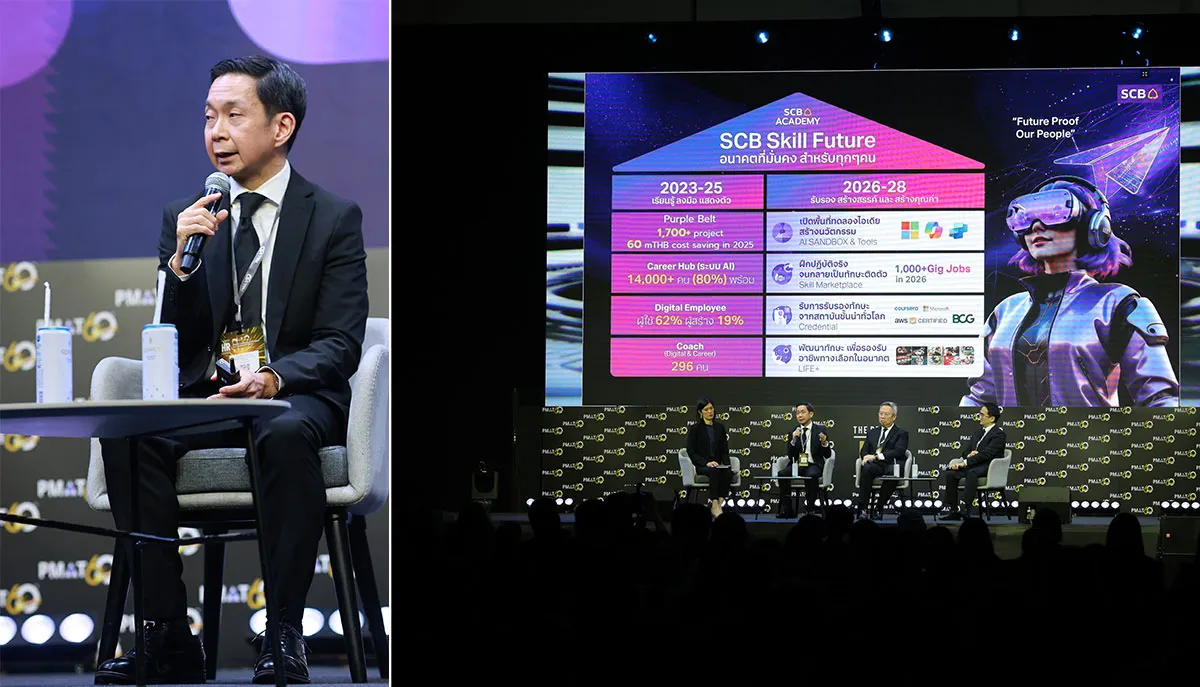
Guided by its core attributes of Productivity, Resilience, and Sustainability, SCB is driving organizational transformation through three strategic pillars:
- Organization Efficiency: Enhancing agility and competitiveness by establishing a Right Size & Right Shape structure under the principle of Execution with Care. This includes strengthening cross‑functional collaboration and optimizing resource utilization to effectively navigate the complexity of today’s business landscape.
- Organization Capabilities: Elevating workforce skills and future readiness through initiatives such as developing leaders under the Leader as Coach model, fostering a culture of continuous learning, and integrating AI and data into work processes. SCB also accelerates upskilling and reskilling via real‑world learning approaches—including sandbox experimentation, international skill certifications, and a dynamic Skill Marketplace that empowers employees to explore cross‑functional roles.
- Organization Well‑being: Promoting holistic physical and mental well‑being to strengthen resilience, balance, and sustained performance amid continuous pressure and change.
Together, these pillars form the foundation of SCB’s people strategy, ensuring the bank remains modern, adaptive, and future‑ready while advancing its vision of a Digital Bank with a Human Touch.
At the heart of its people strategy, SCB places strong emphasis on building Sustainable People, ensuring that employees are supported at every stage of their career journey. SCB is committed to helping all employees—whether continuing within the organization or transitioning beyond it—retain capability, employability, and a secure future.
Through its SCB Be With You program, the Bank provides comprehensive career transition support, including:
- Upskilling and reskilling for new roles
- Resume development and interview preparation
- Job fairs and vocational training
- Entrepreneurship opportunities through franchise models and small‑business loans
The program is designed to ensure that every individual can “secure a job, earn an income, and build a stable future.”
SCB believes that enabling employees to transition sustainably into new career paths is not only a strategic imperative but also a fundamental responsibility of modern HR—reinforcing its vision of a Digital Bank with a Human Touch that integrates innovation with empathy and long‑term people development.

In addition to presenting his strategic vision at the conference, Mr. Suvagondha was honored with the prestigious “HR Leader for Social Impact Award” in recognition of his leadership in advancing people initiatives that deliver meaningful and measurable social impact. His contributions span the promotion of lifelong learning, the creation of programs that strengthen educational institutions, and the enhancement of workforce capability through accessible and inclusive learning models. This award underscores SCB’s unwavering commitment to social responsibility and its dedication to building human capital that benefits both the organization and society at large.
Mr. Suvagondha remarked, “SCB believes this moment marks a critical turning point where HR must transform ahead of the curve—thinking like business leaders, learning faster than the changing world, and being ready to manage both people and AI in parallel. Yet no matter how advanced technology becomes, the essence of people management begins and ends with humanity. This is why SCB continues to advance our People Strategy under the ‘Digital Bank with a Human Touch’ strategy, ensuring that our people truly grow stronger, more resilient, and more sustainable alongside an organization powered by technology.”